
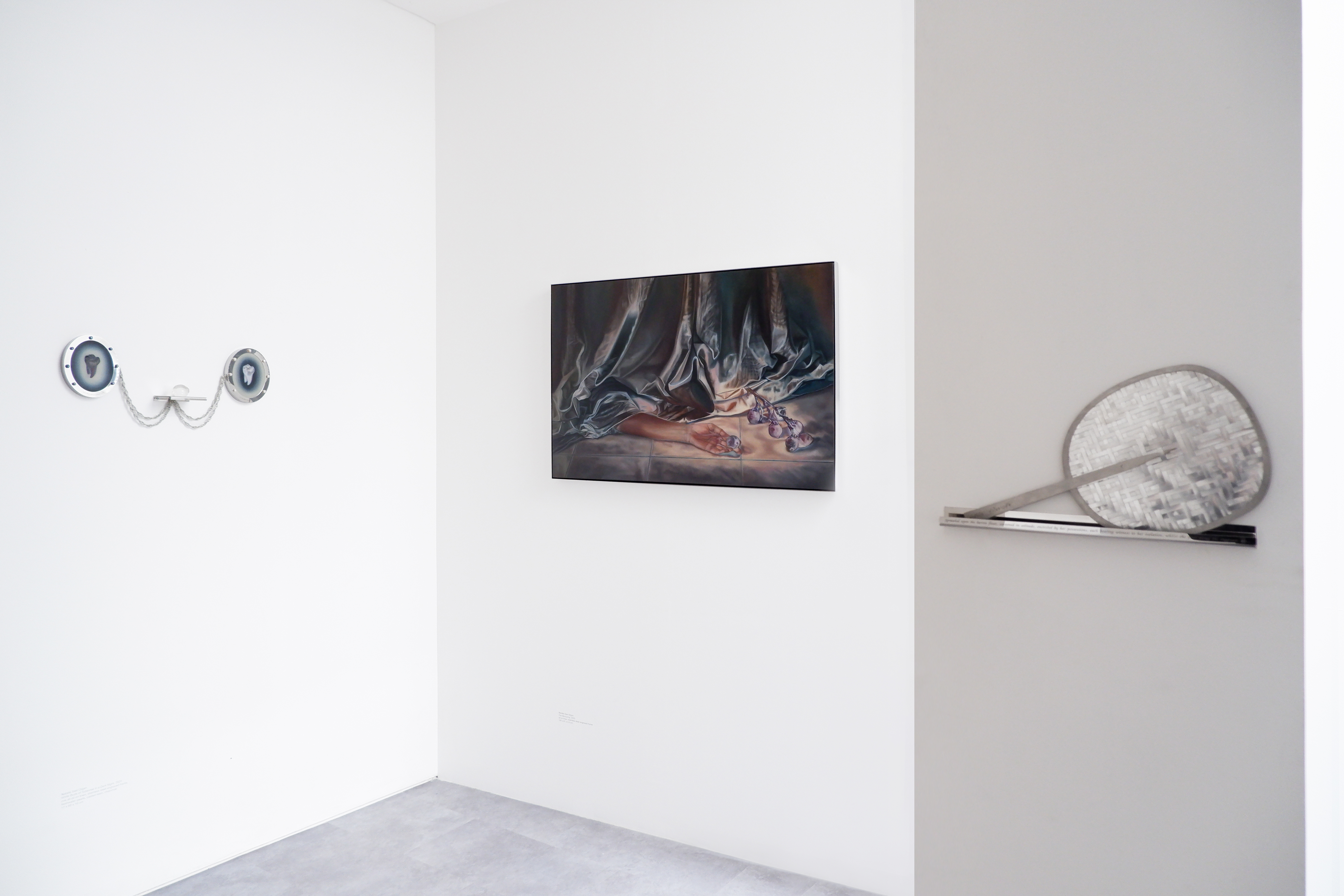
ruins and blueprints
ara contemporary
2025
ruins and blueprints explores the continuous dialogue between the past and the present in a way to trace the origins of current realities, particularly the reinterpretation of historical events or contexts through the lens of present perspectives. Together, the metaphors of 'ruins' and 'blueprints' suggest a cyclical relationship in which the past shapes the present, and the present, in turn, lays the foundation for the future just like a continuous loop of remembering and reimagining.


The Devouring
2025
Oil on linen, stainless steel engraved frame
100 x 67 x 3.5 cm
Natalie Sasi Organ’s painting The Devouring strategically appropriates the formal conventions historically associated with European devotional and narrative painting—not as homage, but as critical intervention. By deploying dramatic chiaroscuro, voluminous drapery, and theatrical composition—visual strategies long used to sanctify religious or mythological subjects—Sasi Organ stages the betel nut, a culturally dense emblem of kinship, ritual, and spiritual continuity in Thailand and Southeast Asia, within a framework typically reserved for Western iconography. This recontextualization is neither pastiche nor mimicry, but a deliberate act of visual restitution: an assertion that the betel nut, though marginalized by modernity, deserves the same gravity, permanence, and reverence afforded to symbols enshrined in the European canon. Encased in a steel frame engraved with Acanthus leaves—a motif ubiquitous in Bangkok’s colonial-era architecture and royal ornamentation, itself a relic of imperial aesthetic diffusion—the work interrogates how certain symbols achieve enduring visibility while others are rendered ephemeral. Through this framing, Sasi Organ proposes a counter-memory: one in which the betel nut is not merely preserved, but reborn, its cultural vitality reanimated through the very mechanisms of representation that once excluded it. The painting thus becomes both archive and altar, insisting on the right of local, intimate, and matrilineal traditions to occupy sacred visual space.


White Buds of Tuberose in a Dark Night
2025
Oil on linen, stainless steel engraved frame, freshwater pearls, casted resin, chainmail
17 x 60 x 10 cm
Once a black void of a woman’s mouth,
now,
our teeth gleam like bullets racing into vanity.
White Buds of Tuberose in a Dark Night interrogates the entanglement of beauty, colonial perception, and cultural memory through the shifting symbolism of the betel nut. The work’s title quotes a line from The Book of Indian Beauty (1981): “Like the white buds of tuberose in a dark night; through the lines of betel shone out her white teeth.” Yet this lyrical image—of luminous white teeth emerging from betel use—is a historical fiction. In Thailand, where betel chewing was deeply woven into rituals of courtship, kinship, and social maturity, blackened teeth were long revered as a mark of refinement and allure. As the 19th-century British traveler John Neale noted in Siam: Its Government, Manners, and Customs (1852): “The Thai women dye their teeth … a jet black colour… The darker the teeth, the more beautiful is a Siamese belle considered.’” Natalie Sasi Organ fabricates her own poem above, tracing the rapid and violent pivot wrought by modernisation, a term the artist believes is actually a form of westernisation: from a practice that encoded intimacy and social belonging to one now dismissed as backward or unsanitary. Referencing ethnographic scholarship such as Dawn F. Rooney’s Betel Chewing Traditions in South-East Asia, the work underscores how something as intimate as the colour of one’s teeth can become a battleground of cultural legitimacy.
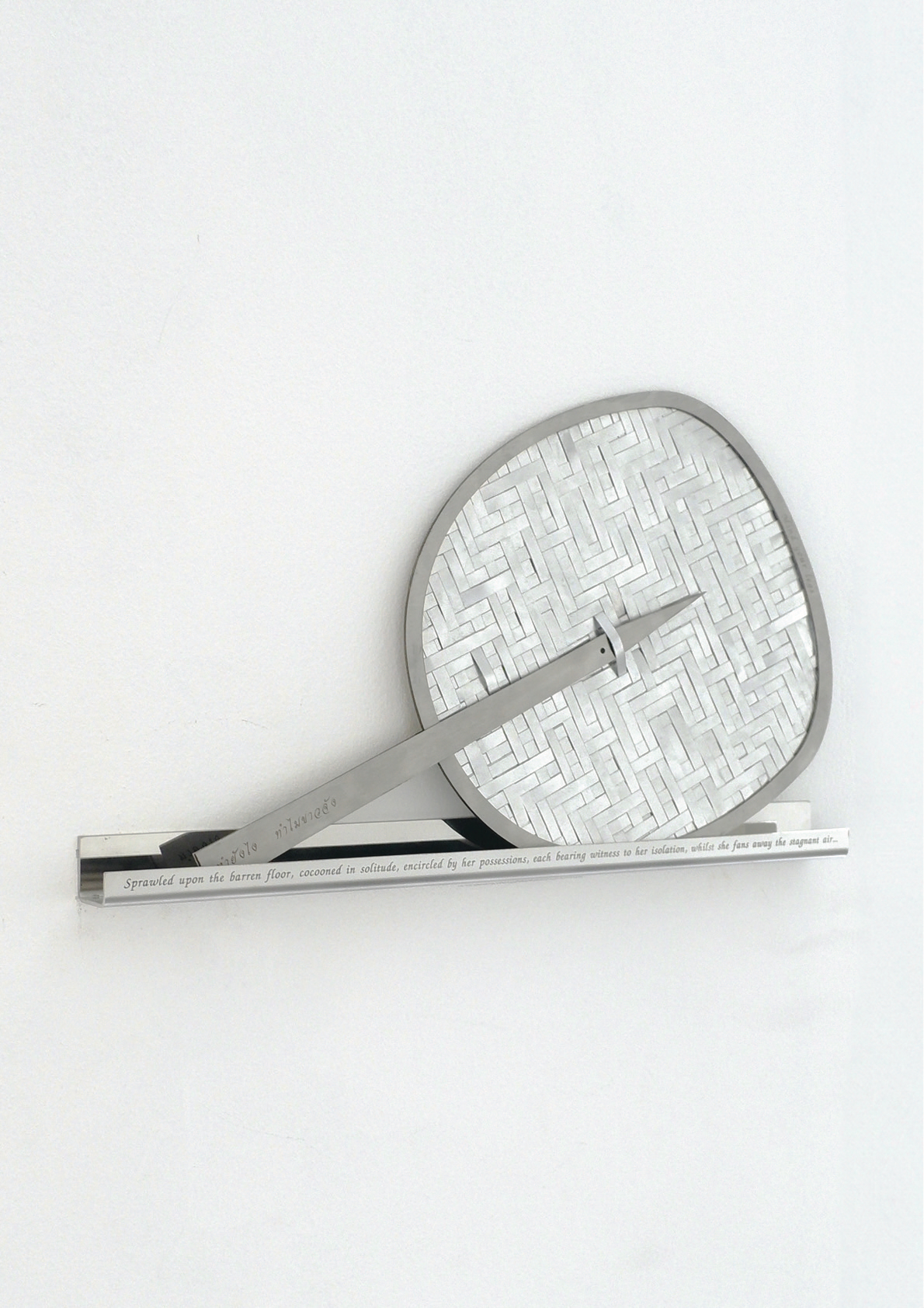

Mind your Legs
2024
Laser engraved shelf, aluminium and steel fan
31 x 18 x 2 cm
Sprawled upon the barren floor, cocooned in solitude, encircled by her possessions, each bearing witness to her isolation, whilst she fans away the stagnant air…
A work dedicated to the artists’ late great grandmother.